Please ensure Javascript is enabled for purposes of website accessibility
Dangerous wildfire smoke impacting more than a dozen states

Dangerous wildfire smoke impacting more than a dozen states


(NEW YORK) — Dangerous wildfire smoke is impacting more than a dozen states on Saturday morning as air quality alerts span from the Upper Midwest and Great Lakes to New England, south through the Northeast and Mid-Atlantic.

More than 900 wildfires are burning across Canada, sending smoke into the Northeast and Mid-Atlantic, though a storm system moving through Saturday could help clear some of the haze.

The Midwest and Upper Great Lakes are expected to see poor air quality through the weekend as northwesterly winds push a plume of smoke into the region.

Meanwhile, the Storm Prediction Center has issued a Level 3 of 5 risk for severe storms across parts of the Ohio Valley, Northeast and Mid-Atlantic. Major cities along the Interstate 95 corridor, including New York, Philadelphia, Baltimore and Washington, D.C., could be affected. Pittsburgh, Cleveland and Buffalo are also expected to see strong storms.

The rounds of showers and storms will bring the threat of damaging winds, hail, a few tornadoes and chances for flash flooding in certain areas.

Flood watches are in effect for parts of the Northeast, including New York City and Philadelphia, through Saturday evening as heavy rainfall could trigger flash flooding.

Elsewhere, monsoonal moisture is expected to extend from West Texas and southern New Mexico into central and northern Arizona and southern Utah, where daytime heating could trigger thunderstorms capable of producing heavy rainfall and flash flooding.

A severe storm threat also extends into parts of Virginia and the Carolinas, where scattered storms could produce damaging winds and heavy rainfall as Charlotte, Raleigh and Virginia Beach are among the cities that could be affected.

Copyright © 2026, ABC Audio. All rights reserved.
Canada wildfire smoke brings unhealthy air quality to over a dozen states in Midwest, Northeast: Latest

Canada wildfire smoke brings unhealthy air quality to over a dozen states in Midwest, Northeast: Latest


(NEW YORK) — Dangerous smoke from hundreds of Canadian wildfires has seeped down to the U.S., impacting over 100 million Americans across more than a dozen states.

Air quality alerts on Friday stretch from the Midwest to the Great Lakes to the Northeast to the Mid-Atlantic, impacting major cities including Chicago, Detroit, Washington, D.C., and Philadelphia.

Canada has nearly 900 wildfires burning, with over 100 categorized as out of control. Almost 200 of the fires are in Ontario.

Heavy rain by the Minnesota/Canada border on Friday may help with some fires, but the storms could also bring strong winds and lightning, which can spark new fires and create more erratic fire activity.

Passing showers and thunderstorms are also possible in Ontario Friday, but that rain won’t be enough to put the wildfires out, and the winds may make conditions worse and lightning could spark new wildfires. There are more chances for rain over Ontario on Saturday and again on Tuesday. 

In the U.S., the smoke Friday spans from Duluth, Minnesota, to Richmond, Virginia, impacting states including Wisconsin, Michigan, Ohio, New York, Pennsylvania, New Jersey, Maryland and Delaware.

Philadelphia issued a “Code Purple Air Quality Emergency Day” Friday.

“Everyone may experience negative health effects from particulate matter in the air,” Philadelphia officials warned. “Members of sensitive groups may experience more serious health effects.”

The worst air quality Friday afternoon is in northern Minnesota and Wisconsin.

In Milwaukee, where the air is in the hazardous category, the Milwaukee Brewers are allowing ticket holders to exchange tickets for Friday night’s game for another regular season home game. 

The air is expected to improve on Saturday in the Ohio Valley, Northeast and the Mid-Atlantic, when rain moves in. But parts of the Midwest and Great Lakes will continue to see dangerous air quality.

Smoke is probable over New York City on Sunday when Spain plays Argentina in the FIFA World Cup Final at MetLife Stadium in New Jersey, though it is still too early to know exactly where the smoke will be. Sources familiar with the situation told ABC News that “all involved authorities are monitoring.”

Smoke contains fine particles that can travel deep into the lungs. For those who need to work outdoors, are more sensitive to smoke or are in a high-risk group, Kai Chen, an associate professor of epidemiology at Yale School of Public Health, told ABC News that the best type of mask to wear is an N95, which is designed to filter at least 95% of airborne particles.

In New York City, Mayor Zohran Mamdani said free KN95 masks are available at hundreds of locations.

Click here to read more on how to stay safe.

Copyright © 2026, ABC Audio. All rights reserved.
Declassified documents touted by Trump say election systems ‘would be difficult to manipulate’

Declassified documents touted by Trump say election systems ‘would be difficult to manipulate’


(WASHINGTON) — Newly-declassified documents touted by President Donald Trump during his address on election security Thursday cast doubt on some of his claims about “shocking vulnerabilities” in the country’s election infrastructure.

While Trump claimed during his address that the nation’s election systems are vulnerable to “hacking, exploitation, and foreign interference,” the intelligence reports released by the White House concluded overall that the main infrastructure used to conduct elections in the United States “would be difficult to manipulate on a wide enough scale to alter the election outcome.”

“Great damage has been done to our country. Our elections were left vulnerable to being rigged and stolen, and the trust of the American people was lost,” Trump said, without providing evidence.

‘Difficult to manipulate at scale’

The documents noted that although some internet-connected election infrastructure — like voter registration databases and pollbooks — are vulnerable to cyberattacks, the systems used to tabulate, transmit, and display election results cannot be manipulated on a wide scale, and audits and paper trails “would uncover such efforts in the nearly all U.S. states.”

“We assess that hostile actors could also manipulate systems that count or tabulate votes — such as voting machines — on a localized basis, but it probably would be difficult to coordinate a campaign to alter voting results on a wide scale,” said an August 2020 report from the National Intelligence Council. “Similarly, foreign actors would have difficulty coordinating a large scale campaign to manipulate mail-in voting, and robust postal tracking probably would detect any large-scale effort.”

The report concluded that cyber attacks could potentially delay voting but “probably would not affect the integrity of certified results.”

While another report said that foreign adversaries such as Russia, China, Iran, and North Korea “have the capability to access and potentially manipulate data in U.S. election-related computer systems,” the report did not identify “specific plans to interfere with the functioning of these systems” or past instances when results were changed due to the actions of foreign actors.

“We assess that vote tabulation systems would be difficult to manipulate on a wide enough scale to compromise election results,” said a January 2020 report from the National Intelligence Council.

“Although an adversary could manipulate voting results across multiple jurisdictions and enough states to influence a presidential election, we judge that conducting such a campaign would be difficult and that postelection audits and paper trails very likely would uncover such an effort,” that report said.

According to the August 2020 report from the National Intelligence Council, the only country that was observed attempting to target or manipulate election systems during the 2020 election was Russia, which used “a range of measures primarily to denigrate former Vice President Biden” and share largely favorable information about President Trump.

‘Delays on Election Day’

According to the National Intelligence Council’s January 2020 report, the systems vulnerable to disruption are official election websites or registration databases — which are often publicly accessible — or poll books, which are used by election officials to look up eligible voters.

The report said that bad actors could “alter data to potentially prevent individual voters or groups of voters from voting, causing delays on Election Day or forcing voters to use provisional ballots” — but those actions wouldn’t affect the votes themselves.

“We assess that cyber operations targeting the electronic tabulation of results could delay results reporting from affected jurisdictions, potentially creating public uncertainty but probably not affecting the integrity of certified results,” the report noted.

According to a 2026 report from the Cybersecurity and Infrastructure Security Agency, election-related software is “subject to the same security concerns as most other software systems.” The report called for election officials to be transparent about issues to improve public trust.

“By openly acknowledging incidents and describing mitigation steps, vendors and localities can show that they are proactively defending critical infrastructure rather than obscuring vulnerabilities. This transparency encourages continuous improvement, drives investment in stronger defenses, and reinforces that protecting elections is a collective national priority,” the report said.

‘Russia, China, Iran’

A January 2020 memo from the National Intelligence Council warned that countries like Russia, China, Iran and North Korea “have the capability to access and potentially manipulate data in U.S. election-related computer systems” — but a subsequent report said such manipulation would be hard to do on a widespread basis.

“We judge that Russia, China, Iran, as well as many nonstate actors, have the capability to conduct such activities, although it would be difficult for them to manipulate voting processes at scale and without detection,” the report said.

Russia and China have pushed back against those claims.

The January 2020 report noted that Russia “almost certainly” surveyed election networks in 2016, accessed election infrastructure in two states, and exfiltrated voter data from one state.

According to the August 2020 report, Russia sought to amplify discord in the United States ahead of the 2020 election, spread false claims about then-candidate Joe Biden, and boost positive information about Trump.

The 2020 CIA memo noted that China probed presidential campaigns in every election since 2008 to get insights on U.S.-China issues.

According to the memo, the intelligence community detected Chinese state-sponsored cyber actors specifically targeting the Biden campaign “to gather intelligence that could enable future operations.”

“The IC assesses that China does not currently intend to covertly interfere to try to sway the outcome of the election, although this activity could enable such operations,” the report said.

An August 2020 report from the National Intelligence Council concluded that China “did not intend to try to affect the election” though it “prefers that President Trump be defeated.”

“We assess that China prefers that the President whom Beijing sees as unpredictable and tough on China does not win reelection,” the report said.

However, an October 2020 memo noted the overall intelligence community believed that China considered but did not deploy influence efforts for the upcoming 2020 election. The memo said that Chinese leadership believed Trump appeared likely to lose and that “there is little point to taking the risk of an influence effort because they believe their preferred outcome is probable.”

“As early as [REDACTED] this year, Chinese [REDACTED] assessed that the pandemic and economic downturn had diminished the President’s reelection prospects and since then Beijing has been planning for either electoral outcome and conducting outreach to both candidates and their campaigns, [REDACTED],” the memo said.

The August 2020 report noted that Iran “is conducting an influence campaign to undermine the current President and US democratic institutions, and to divide the country in advance of the 2020 elections.”

However, the report noted that Iran is focusing on covert online influence — such as sharing memes and recirculating news reports that are critical of Trump.

“Iran could attempt to manipulate or attack election infrastructure as it has in elections in the Middle East and South Asia — but we do not have any information indicating that it intends to do so in the United States,” the report said.

‘An election outside of Venezuela’

The release of documents included a CIA assessment from June 2026 summarizing the last two decades of intelligence related to Venezuela’s manipulation of voting systems, following longstanding claims by Trump’s far-right supporters of Venezuela’s involvement in 2020 election interference.

The memo said that Venezuelan government officials developed the capability to manipulate electronic voting systems in their own elections, including replicating and overwriting voting data to make fraudulent votes legitimate.

However, the report noted that the intelligence “did not definitively confirm that large-scale electronic fraud was successfully executed in specific Venezuelan elections.”

Notably, the report noted that there was no evidence that the Venezuelan government was able to manipulate election results outside of their own country, because their ability to rig elections “rested in part on its ability to control every stage of the electronic voting process.”

“Neither [the voting machine company] Smartmatic nor the Venezuelan Government had the capability — that is the level of control or access required — to manipulate the outcome of an election outside of Venezuela in a predictable fashion,” the report said.

‘False narratives’

In addition to assessing technological vulnerabilities in the election system, a newly-declassified memo from the National Intelligence Council explicitly raised concerns about adversaries exploiting most Americans’ lack of knowledge about voting systems to “undermine confidence in U.S. democratic processes.”

“Much of the voting public probably knows little about the process of administering U.S. elections, which could allow false narratives to gain traction,” said the January 2020 memo.

The memo noted that efforts to “publicly invalidate such claims could take weeks or months” and that “disproving claims would also be impossible if adversaries evaded U.S. intelligence collection.”

“A widely publicized compromise of election infrastructure probably would undercut public confidence in the election, even if the compromise was not used to manipulate election-related data or systems,” the memo said.

Copyright © 2026, ABC Audio. All rights reserved.
2 Florida deputies airlifted after shooting, suspect dead

2 Florida deputies airlifted after shooting, suspect dead


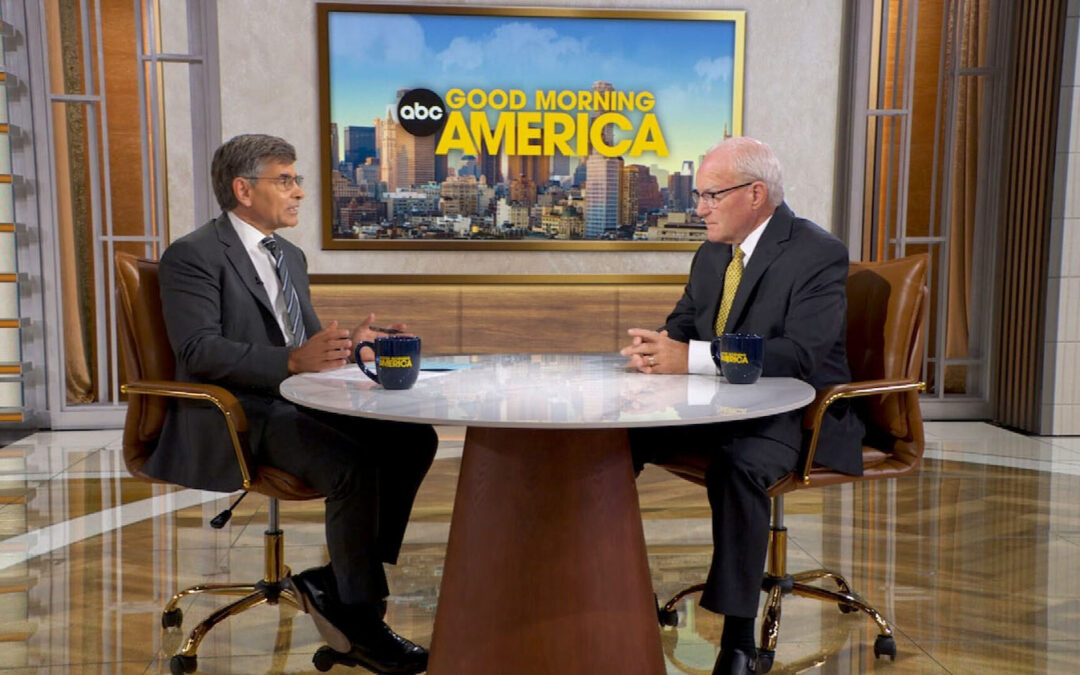
(RUSKIN, Fla.) — Two deputies were airlifted to a Florida hospital Thursday after they were shot while approaching a suspect who was accused of holding a woman hostage overnight, according to the Hillsborough County Sheriff’s Office.

The suspect, identified as 34-year-old Chris Dmuchowski, was shot by a third responding deputy and died after being transported to the hospital, the sheriff’s office said.

Both deputies are receiving care and are expected to make a full recovery, according to an update from the sheriff on Friday.

Deputies arrived on the scene on West Shell Point Road in Ruskin, Florida, after a report that the suspect had taken his ex-girlfriend hostage overnight, Hillsborough County Sheriff Chad Chronister said in a press briefing Thursday.

The suspect allegedly restrained his ex-girlfriend at her residence and threatened to kill her, and then released her after she regained consciousness in the morning, Chronister said.

That morning, she went to a sheriff’s office building to request an order of protection, after which authorities sent a drone to the scene upon identifying the suspect and learning of his criminal record, according to the sheriff.

An exchange of gunfire ensued in the parking lot outside of the residence after the suspect exited the building, the sheriff said.

“Our suspect ambushed our deputies from the moment they arrived on scene,” Chronister said. “He was intent on taking the life of a deputy sheriff.”

The suspect opened fire at two deputies, striking one in the face and another in the neck area, after which a third deputy approached and shot the suspect multiple times, Chronister said.

Chronister said on Friday that one of the deputies was preparing to go into surgery. He had multiple fractures on his hand and wrist and had gotten stitches on his face where the bullet struck, according to the sheriff.

The other deputy who was shot in the neck experienced no damage to vital arteries and hopes to be released Friday, Chronister said.

Dmuchowski was a one-time convicted felon on charges of tampering with physical evidence.

The sheriff’s office said there is no threat to public safety at this time.

“Thank you to every single deputy who was on scene and responded to this scene today,” Chronister said.

Copyright © 2026, ABC Audio. All rights reserved.
Family sues New York City utility over woman’s fatal manhole fall

Family sues New York City utility over woman’s fatal manhole fall


(NEW YORK) — The family of a Westchester grandmother who died after falling into an open manhole in Midtown Manhattan filed a wrongful death lawsuit against the utility responsible for the manhole, alleging its workers failed to properly seal the cover.

Donike Goncaj, 56, fell into the manhole at 52nd Street and Fifth Avenue on May 18 and died of scald burns and thermal inhalation from the steam. The lawsuit, filed in New York State Supreme Court on Thursday, says she suffered “severe, horrifying, and catastrophic injuries.”

The Office of the Chief Medical Examiner ruled Goncaj’s death an accident.

The utility, Con Edison, concluded a truck ran over the manhole and dislodged the cover and noted in a statement in May that “while this is a rare occurrence, manhole covers can get displaced by heavy vehicles.”

The lawsuit, filed by Goncaj’s son on behalf of her estate, and her domestic partner, alleged ConEdison “should have known that dislodged and displaced manhole covers presented a recurring and foreseeable danger to pedestrians” and accused the utility of negligence, carelessness and reckless disregard for their mother’s safety.

Someone falling to their death in a manhole “ordinarily does not occur in the absence of negligence,” the lawsuit said.

The lawsuit contended that ConEd and its contractors “had a duty to maintain” the manhole “in reasonably safe conditions,” including warning pedestrians and providing a ladder or staircase to exit it.

ConEd did not immediately comment on the suit. In May, it said it was investigating the situation and working with the city in its probe.

“Our thoughts remain with her family, and safety remains our top priority,” ConEd said in a statement a day after the incident.

According to the lawsuit, Goncaj’s domestic partner, Jashar Kameraj, witnessed her falling into the scalding hot manhole and tried to rescue her, to no avail.

Kameraj and Goncaj’s son are seeking unspecified damages.

-ABC News’ Ivan Pereira contributed to this report.

Copyright © 2026, ABC Audio. All rights reserved.
‘Where is Roker?’ Man snuck into 30 Rock looking for ‘Today’ show host, police say

‘Where is Roker?’ Man snuck into 30 Rock looking for ‘Today’ show host, police say


(NEW YORK) — A man is facing charges, including menacing as a hate crime, after he allegedly snuck into an NBC building at New York City’s Rockefeller Center looking for “Today” show weather anchor Al Roker, authorities said.

The suspect, Andrew Truelove, gained access to the “Today” studio on Thursday morning by entering the lobby and closely following an NBC employee who used an ID card to scan into the building, Rockefeller Center security personnel told authorities.

Truelove allegedly loitered at the bottom of a stairwell before calling out, “Where is Roker?” according to a criminal complaint.

He then allegedly took steps toward “Today” anchor Craig Melvin and repeatedly uttered a racial slur, the complaint said.

Truelove, 41, of Manhattan, was detained by an NYPD officer working a paid detail, police said.

He was charged with burglary as a hate crime, menacing as a hate crime, criminal trespass as a hate crime and harassment, according to police. He appeared in court on Friday, where a judge set bail at $10,000.

Police sources told ABC News Truelove is a Sandy Hook school shooting denier who has been arrested numerous times, including in his native Virginia, for allegedly stealing signs dedicated to Sandy Hook victims.

Melvin wrote on Instagram after Thursday’s incident, “I’m doing just fine. Thanks for reaching out.” He added on “Today” on Friday, “We are cooperating fully with the NYPD as they investigate the matter and we are just very happy that everyone is safe.”

Roker wrote on Instagram Friday morning, “A really heartfelt thank you to all who reached out over the last 24 hours to check in on my brother, craigmelvinnbc. We are both okay. It’s moments like these that serve to pull us together.”

NBC News did not respond to ABC News’ request for comment, but Melvin shared a statement from NBC News on Instagram, which said the person “entered an unauthorized area ” and “approached anchor Craig Melvin, who alerted security.”

“The individual was detained and taken into custody by law enforcement without further incident. There was no altercation, and no one was injured,” NBC said.

NBC said it takes “the safety and security of our employees, talent, staff and guests extremely seriously. We are reviewing the incident and our security protocols and remain committed to providing a safe and secure environment for everyone who works at and visits our studios.”

Copyright © 2026, ABC Audio. All rights reserved.