Please ensure Javascript is enabled for purposes of website accessibility
Severe weather to impact parts of US over Labor Day weekend

Severe weather to impact parts of US over Labor Day weekend


Severe, damaging thunderstorms targeted parts of the Southeast on Saturday, with more severe weather possible on Sunday.

Several homes were damaged due to fallen trees in Rogersville, Tennessee and the community of Persia, Tennessee, and injuries were reported. In North Carolina, Fayetteville Airport reported a 72 mph wind gust from thunderstorms.

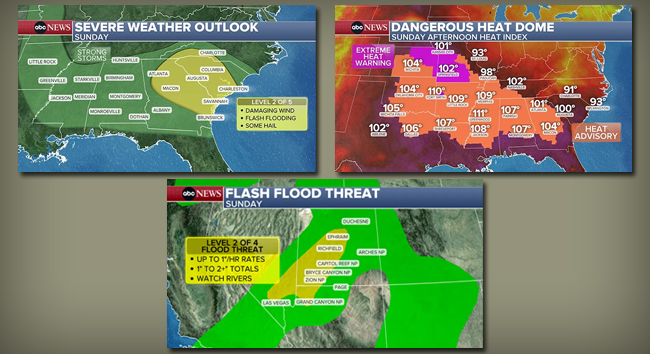
On Sunday, a level 2 out of 5 “slight risk” for severe weather is in effect for parts of Georgia, North Carolina and South Carolina, including Atlanta, Savannah, Columbia, Charleston and Charlotte.

Damaging winds and flash flooding are the main threats, but some hail is also possible.

The same “slight risk” for severe weather exists Sunday in parts of Montana, including Great Falls and Butte. Damaging winds and large hail are the main threats with storms later today in the area.

While portions of the Southeast faced severe weather for the first part of the holiday weekend, it’s important to note that overall, much of the country is experiencing quiet conditions weather-wise for the Labor Day holiday weekend.

For the Labor Day holiday on Monday, there is no organized severe weather threat as much of the country continues to enjoy rather tranquil weather. Some areas could still see scattered thunderstorms which could bring lightning, gusty winds and downpours in spots.

Triple-digit heat scorches the Southeast

Dangerous heat persists for millions as the holiday weekend continues, with more than 40 million Americans under heat alerts Sunday from Kansas to Georgia.

Heat indices are soaring into the triple digits across this large swath of the country later Sunday afternoon.

Cooler and more comfortable conditions continue to settle in for much of the Northeast and will do the same farther south along much of the East Coast later Sunday.

Afternoon high temperatures will be in the mid-80s in Washington, D.C., Sunday and in the 70s in New York City Sunday and on Monday.

Raleigh, North Carolina will see highs decrease to the mid-80s Sunday after a long stretch of brutal heat.

However, parts of the Plains and South will remain very hot through the new workweek. An Extreme Heat Warning remains in place for Kansas City through Tuesday. Highs will be in the mid-90s each day, with feels-like temperatures up to 105 degrees during the afternoon.

Flash flood threat

On Sunday, the potential for flash flooding returns to parts of the Southwest, with a level 2 of 4 risk over parts of southern Nevada, northern Arizona and Utah.

This includes many national parks in Arizona and Utah on Sunday, including Grand Canyon National Park, Zion National Park and Bryce Canyon National Park, all which recently experienced significant flash flooding impacts from monsoon storms.

A Flood Watch has been posted for Sunday across portions of Utah, including Cedar City, Beaver Richfield and Price, as well as Zion National Park and Bryce Canyon National Park.

While the threat is not as widespread and intense as the previous event, scattered thunderstorms later in the day could bring downpours and frequent lightning. Flash flooding is possible where the heaviest rain develops.

Any burn scar areas from recent wildfires in Utah and Arizona will be especially vulnerable to any heavy rain that falls on Sunday.

Tropical storm warning issued for parts of Hawaii

Hurricane Lowell and Tropical Storm Karina will bring high surf impacts to the Hawaiian Islands through the holiday weekend, while Lowell is expected to bring heavy rain to Hawaii.

The National Weather Service issued a tropical storm warning for Kauai County on Sunday, saying tropical storm conditions were expected for Kauai Northwest Waters, Kauai Windward Waters, Kauai Leeward Waters and Kauai Channel on Monday morning and lasting through Tuesday afternoon.

Lowell has weakened slightly back to a Category 3 hurricane, with maximum sustained winds of 125 mph. It’s moving to the north-northwest at 6 mph with the center currently located roughly 600 miles southwest of Honolulu.

Lowell is forecast to remain a major hurricane over the next 24 hours but a weakening trend is expected to take over as it continues its turn to the north. The tropical system is still forecast to pass west of the main Hawaiian Islands late Monday into Tuesday.

Lowell is already bringing high surf to the south- and southeast-facing shores of the islands. A High Surf Advisory in effect for waves up to 12 feet along these shorelines.

While landfall is not expected, some of the outer bands of Lowell could impact the western Hawaiian Islands early this week.
 

Copyright © 2026, ABC Audio. All rights reserved.
Lindsay Clancy trial: Judge declares mistrial after emergency request denied

Lindsay Clancy trial: Judge declares mistrial after emergency request denied


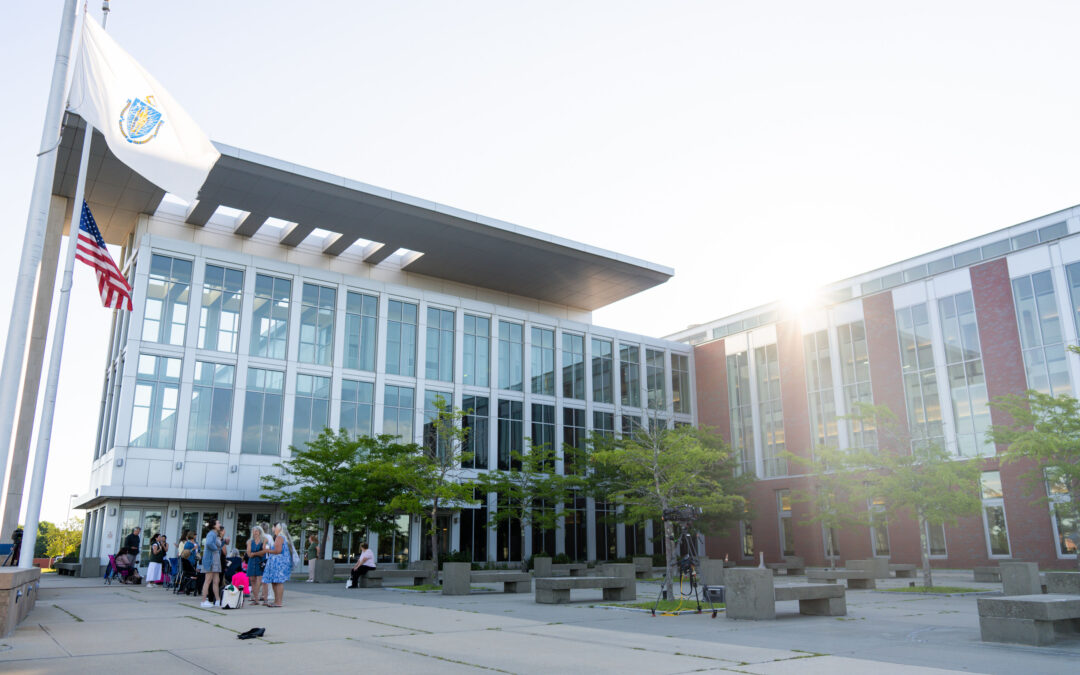
(NEW YORK) — The murder trial of Lindsay Clancy, the Massachusetts mom who killed her three young children while in the family’s home on Jan. 24, 2023, has ended in a mistrial after seven days of juror deadlock.

Clancy’s defense attorney, Kevin Reddington, claims she was suffering from postpartum psychosis when she strangled her children and attempted to take her own life. The prosecutors, Jennifer Sprague and Shanan Buckingham, argue that Clancy — who pleaded not guilty to three counts of first-degree murder — is criminally responsible for her children’s deaths.

Judge William Sullivan, who is overseeing the trial, has set a court date of Sept. 29, 2026, to reconvene and determine next steps.

Copyright © 2026, ABC Audio. All rights reserved.

ICE agent faces federal charges for allegedly lying about Minneapolis shooting, filing shows

ICE agent faces federal charges for allegedly lying about Minneapolis shooting, filing shows


(NEW YORK) — An Immigration and Customs Enforcement agent who is accused of shooting a Venezuelan man in Minneapolis in January and then lying about the incident was charged with six federal counts of making materially false statements, according to a copy of the federal indictment unsealed Friday. 

The charges mark the first federal case by the Trump administration against an ICE officer involved in its nationwide immigration surge enforcement operations. 

The charges come just one week after Christian Castro, 52, was released from jail by authorities amid an extradition dispute over separate state-level charges leveled against him by officials in Minnesota. 

The federal case stems from statements Castro allegedly made following shots he fired on Jan. 14 at the front door of a home in Minneapolis amid the Trump administration’s immigration crackdown in the city, one of which hit the leg of Venezuelan immigrant Julio Sosa-Celis, according to the indictment.

Sosa-Celis was charged by the U.S. Attorney’s Office in Minnesota following the shooting based on allegations leveled by Castro that Sosa-Celis and another individual in the residence attacked him, but the case was dropped after ICE said that video evidence surfaced showing Castro lied about the encounter.

The indictment accuses Castro of falsely claiming to the FBI that he only fired shots into the residence after being violently attacked by individuals using a broom and shovel to strike him. He is further accused of lying to the FBI after the shooting by claiming he fired one of the rounds while sitting after being attacked and claiming his scuffle with the man he was trying to apprehend prior to the shooting lasted “approximately three minutes,” according to the indictment.

“This statement and representation was false because, as Castro then and there knew, the following facts were actually correct: The interaction described by Castro occurred over a period of approximately eleven seconds,” the indictment stated.

Castro self-surrendered Thursday after being charged, according to sources familiar with the matter. He is expected to make his initial appearance before a federal judge in Texas on Friday.

An attorney for Castro could not immediately be reached for comment Thursday afternoon. 

In May, Castro was separately charged by Hennepin County Attorney Mary Moriarty with four counts of second-degree assault and one count of falsely reporting a crime, leading to a bitter fight between state officials in Minnesota and Texas, where the ICE agent was arrested.

Minnesota Attorney General Keith Ellison sued Texas Gov. Greg Abbott, seeking to force Castro’s extradition, but last week a federal judge ruled he had no authority to intervene in extradition disputes between the states. 

Castro has not yet entered a plea to the state or federal charges.

Career prosecutor involved in probe fired: Sources

The federal investigation into Castro has also led to new fallout between career prosecutors in Minnesota and officials at the Justice Department’s headquarters in Washington, D.C., sources familiar with the matter told ABC News. 

A career prosecutor who had previously helped lead the investigation was fired Thursday, sources told ABC News, after ProPublica published a letter they obtained in which he claimed he was being stymied by senior DOJ officials in bringing a more significant civil rights charge against Castro. 

According to ProPublica, the assistant U.S. Attorney, Matthew Evans, said in the letter to Sosa-Celis’ lawyer that the agent would likely only face lower-level false statements charges despite Evans’ “strongest possible” objections. 

According to ProPublica, Evans said he believed the office had sufficient evidence to charge Castro with a more significant civil rights offense known as “deprivation of rights under color of law,” but claimed U.S. Attorney Daniel Rosen and officials at Main Justice headquarters overruled him. 

Sources familiar with the matter told ABC News on Thursday that Evans has since been fired from the department and disputed his characterization of the investigation, saying the civil rights probe into Castro is still ongoing, and a determination still hasn’t been made whether he’ll face additional charges. 

ABC News was not immediately able to reach Evans for comment Thursday, and received an auto-reply from his office email stating he was now “on leave.” 

A Justice Department spokesperson did not immediately respond to a request for comment. 

Copyright © 2026, ABC Audio. All rights reserved.

Suspect in Minneapolis apartment shooting opened fire after custody exchange, officials say

Suspect in Minneapolis apartment shooting opened fire after custody exchange, officials say


(MINNEAPOLIS) — A man who allegedly shot and killed two residents and wounded several other people, including police officers, at his Minneapolis apartment building opened fire on the victims following a custody exchange, authorities said.

The suspect — who was armed with a handgun — is dead and an autopsy is underway, Minnesota Bureau of Criminal Apprehension Superintendent Drew Evans said at a news conference Thursday. His cause and manner of death are not clear but investigators believe he “died in an exchange of gunfire” with officers, Evans said.

Wednesday afternoon’s shooting began outside the suspect’s apartment building during what appeared to be an arranged custody exchange, Evans said. The gunman allegedly shot and wounded his child’s mother, Evans said, adding that the child was able to escape and was not physically harmed.

As the gunman went inside the apartment building, he shot and wounded two building employees, Evans said.

The suspect then took the elevator to ninth floor — where his apartment was — and he allegedly shot and killed two men in their 60s who also lived in the building, Evans said.

Responding officers heard the gunfire and followed the sound to the ninth floor, where they encountered the suspect and exchanged gunfire, Evans said.

The suspect died and two officers were shot and injured, Evans said, noting that a third officer was not shot but also wounded.

When officers arrived on the ninth floor they “encountered a haze that significantly limited their visibility,” Minneapolis Police Department spokesperson Garrett Parten said Wednesday.

Four officers “experienced adverse effects” from the hazy unknown substance, police said, and two additional officers were injured when their squad car was involved in a crash while responding to the shooting.

A motive is not clear, interim Minneapolis Police Chief Bill Peterson said Wednesday. Law enforcement sources told ABC News investigators are probing whether the suspect had some connection to the building, including whether he was a former or current tenant and whether he was under an eviction notice.

Asked about the potential eviction notice, Evans told reporters Thursday, “That will all be part of our investigation.”

“The residents that were shot and killed on the ninth floor, the exact relationship he had with any of them, and whether or not they were a part of some of the information that was leading up to the eviction process that was underway by the building, is something that we will unpack, and I don’t have specifics right now,” Evans said.

Evans added, “This is once again a situation where domestic violence is center and central to a really terrible situation with multiple people shot. And the role that domestic violence continues to play in mass casualty incidents … continues to be a problem.”

ABC News’ Luke Barr and Emily Shapiro contributed to this report.

Copyright © 2026, ABC Audio. All rights reserved.
Trump appeals to Supreme Court to allow White House ballroom construction to continue

Trump appeals to Supreme Court to allow White House ballroom construction to continue


(WASHINGTON) — The Trump administration is asking the Supreme Court to allow construction of President Donald Trump’s White House ballroom to continue after a lower court put it on pause.

The administration on Friday asked the high court for an emergency stay of the injunction, which would halt substantial portions of the above-ground construction of the White House East Wing and ballroom while litigation plays out over its legality.

The injunction is set to take effect on Aug. 21 unless the Supreme Court acts.

The district court order would still allow below-ground construction or any other measures necessary to protect national security and the president’s safety.

Solicitor General John Sauer called the injunction “extraordinary and unlawful,” arguing that it would put the security of the president and his family at risk and override the advice of the nation’s top military, intelligence and law enforcement officials. 

“If allowed to go into effect, the injunction would wrongfully install a single district judge as sole arbiter of what further construction is ‘strictly necessary’ to protect the safety of the President, his family, staff members, and visitors to the White House, including foreign dignitaries, and presidents and prime ministers of other countries,” Sauer wrote. 

The district court concluded that President Donald Trump lacks the authority to overhaul the White House without congressional approval. A divided federal appeals court upheld the ruling earlier this month. 

In his appeal to the justices to intervene, Sauer suggested halting construction would directly put the life of the president at risk, citing six “recent assassination attempts,” including “the threat of a missile attack against Air Force One on July 8.”

“The President of the United States of America is not a tenant, but rather the sole, elected head of the Executive Branch, and Congress has authorized him to renovate, secure, and protect the White House and its grounds, as other Presidents  have been allowed to do, without exception,” he wrote. 

The government argued that it is likely to win on appeal in the case, insisting that the National Trust for Historic Preservation lacks standing to bring the lawsuit and that federal law has long allowed presidents to undertake the “care, maintenance, repair, alteration, refurbishment, and improvement … of the Executive Residence at the White House.” 

The Supreme Court is expected to seek a response from the National Trust for Historic Preservation sometime in the next week before rendering a decision on the stay. 

Sauer indicated that the administration also plans to ask the Supreme Court to take the case up for expedited oral argument and decision on the merits. 

Separately, the administration’s filing appeared to provide new details about the state of the construction operation. 

The government asserts that it is “on time” and “under budget” and that “zero taxpayer dollars are needed or required.” 

Though there is no mention of the White House’s $1 billion funding request to Congress for White House hardening and enhancements for evolving threats and technology which have been widely seen by lawmakers as related to Trump’s ballroom.

Senate Democrats on Wednesday formally asked the Government Accountability Office (GAO) to conduct an audit of the project and its funding.

“The scale of this project, the destruction of historic architecture, the opaque and unorthodox combination of public funds with private funding sources, and the absence of standard federal review processes raise serious concerns about transparency, accountability, and stewardship of this national landmark,” the lawmakers wrote.

Sauer claimed in Friday’s filing that the project is 65% complete and that $200 million has been spent or committed to date. 

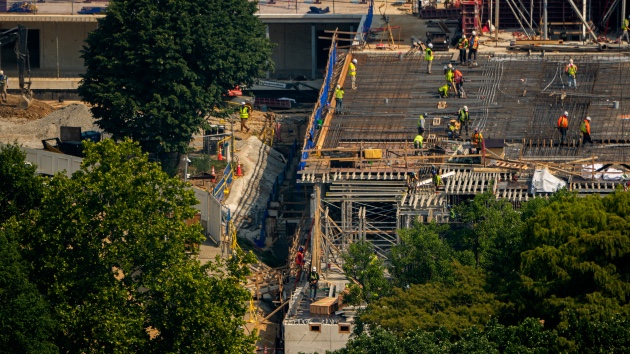
He says a 250-person crew is working 20 hours a day, 7 days a week. The structure is said to be 5 stories deep and 70-feet above ground across 50,000 square feet. 

The administration’s filing also includes sworn declarations from some of the most senior officials in the government, including from the secretary of state, the chairman of the Joint Chiefs of Staff as well as the heads of the FBI and Secret Service, in an effort to dramatically lay out the national security justifications for the ballroom.

One White House official also said in a declaration that the construction is simply too far along for the project to be safely stopped.

“[I]f work is stopped in line with the district court’s injunction, it will be a disaster,” wrote Joshua Fisher, the White House director of management and administration.  “Quite frankly, if the building were tragically ordered to be taken down, or even altered, by the court, there would be no way to do so.”

Fisher says the concrete-and-steel superstructure is now “beyond the point of no return,” adding that the freestanding walls “cannot be left as-is without being tied together with the designed structural steel.”

Copyright © 2026, ABC Audio. All rights reserved.